Understanding data can be daunting, but bell-shaped dot plots offer a powerful and intuitive way to visualize your findings. This guide provides a step-by-step approach to creating and interpreting these valuable tools, suitable for students and anyone with a basic grasp of statistics. We'll explore how they reveal central tendencies, variability, and outliers, ultimately allowing you to extract meaningful insights from your datasets.
Understanding Bell-Shaped Dot Plots
A bell-shaped dot plot, also known as a normal distribution dot plot, is a visual representation of data that showcases its distribution around a central point. Unlike histograms that group data into ranges, each data point in a dot plot is individually represented as a dot, providing a detailed view, especially beneficial for smaller datasets. This granular level of detail allows for easy identification of every data point and any potential outliers. Do you find yourself often needing a detailed view of your data's spread? Bell-shaped dot plots might be your answer.
Advantages of Using Bell-Shaped Dot Plots
Several advantages make bell-shaped dot plots a popular choice for data visualization:
- Intuitive Clarity: Their simplicity makes them easily understandable, even for those without extensive statistical knowledge. Wouldn't it be great to effortlessly grasp the essence of your data?
- Detailed Perspective: Each data point is visible, providing a precise picture of your data's distribution, avoiding the potential loss of information inherent in other methods. Have you ever missed a crucial detail due to data aggregation?
- Symmetry Assessment: A perfectly symmetrical bell shape indicates a normal distribution, simplifying analysis significantly.
- Outlier Detection: Easily identify outliers – data points far from the main cluster – allowing investigation into whether they are errors or significant findings. Have you ever uncovered valuable insights by identifying outliers?
Creating Your Bell-Shaped Dot Plot: A Practical Guide
Constructing a bell-shaped dot plot is a straightforward process:
Data Collection: Gather your numerical data. This could range from test scores to daily sales figures. What data are you ready to visualize?
Range Determination: Identify the lowest and highest values in your dataset to establish the plot's boundaries.
Scale Selection: Choose an appropriate scale for the horizontal (x) axis. Ensure all data points comfortably fit, avoiding overcrowding or excessive spacing. How will you optimize your scale for clarity?
Point Plotting: Position a dot above the corresponding value on the x-axis for each data point.
Interpretation: Analyze your completed plot. Does it resemble a bell curve? Are there any outliers that require further investigation? What story does your data tell?
Interpreting Your Bell-Shaped Dot Plot: Unveiling Data Insights
Once your plot is complete, focus on these key aspects:
Central Tendency: The middle of the bell shape represents the average (mean) of your data, designating the typical value.
Data Variability: The width of the bell reflects the spread or variability of your data. A wider bell indicates greater diversity; a narrower bell suggests higher consistency. How does the spread of your data reflect its stability?
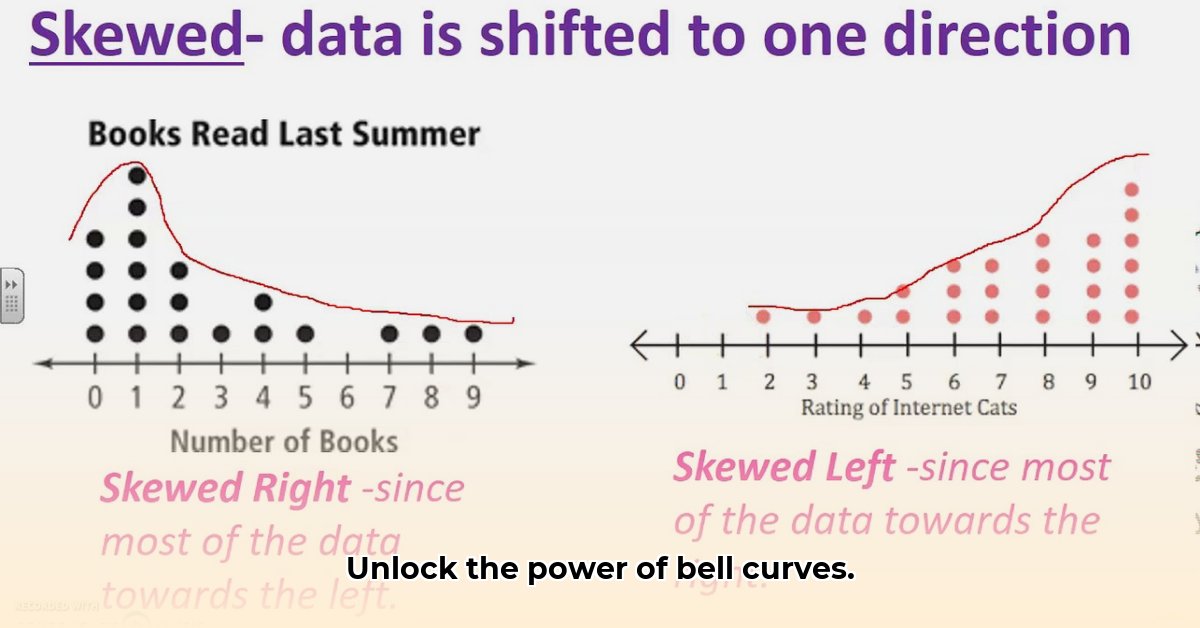
Symmetry Analysis: A symmetrical bell shape strongly suggests a normal distribution. Asymmetry indicates a skewed distribution, with data points clustered more densely on one side.
Outlier Analysis: Examine any outlying dots. Are they errors or potential discoveries?
Comparing Bell-Shaped Dot Plots and Histograms
Both bell-shaped dot plots and histograms display data distributions, but their approaches differ. Histograms group data into bins, obscuring individual data points, while bell-shaped dot plots highlight each point, offering a more granular view. For smaller datasets, the detailed perspective of a dot plot is often preferred. When would you choose a histogram over a dot plot, and vice versa?
Limitations of Bell-Shaped Dot Plots
While highly useful, bell-shaped dot plots aren't always ideal. They work best when:
- Your data is approximately normally distributed or shows a clear central tendency.
- Your dataset is not excessively large; too many data points can result in a cluttered and difficult-to-interpret plot.
For heavily skewed data or very large datasets, alternative visualization tools such as box plots or histograms might be more effective. The optimal visualization method always depends on your specific data and goals.
By mastering bell-shaped dot plots, you'll significantly enhance your ability to understand and interpret data, uncovering valuable insights from your analysis.